When does a collectibles market stop behaving like a hobby—and start behaving like an unlisted asset market?
Not simply when prices rise. The transition begins when a newly released card can be identified, graded, population-tracked, priced across regions, and assigned a comparable market capitalization—all within a matter of months. By that measure, the Pokémon market of 2025–26 is moving beyond blind-box-style consumption and into a phase of pre-financialization.
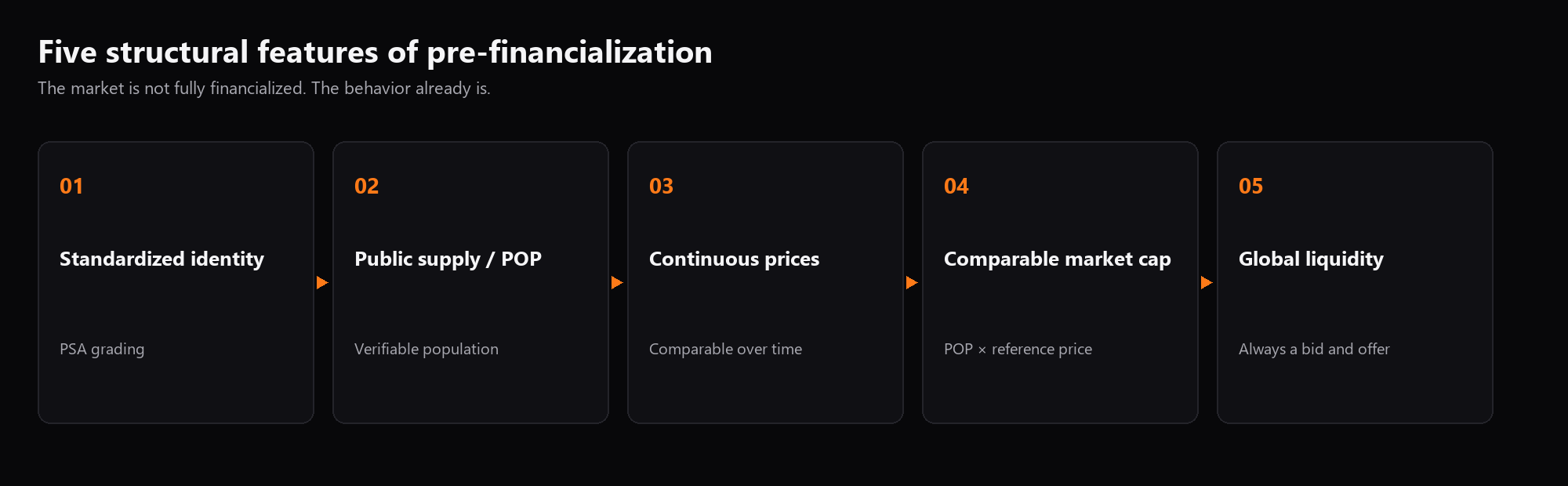
It is not yet a formal financial market. Yet the underlying infrastructure is becoming recognizable: standardized asset identity, visible supply, continuous pricing, cross-market comparability, and a rapidly accelerating pace of capitalization.
The Breakout Story Is Speed, Not Price
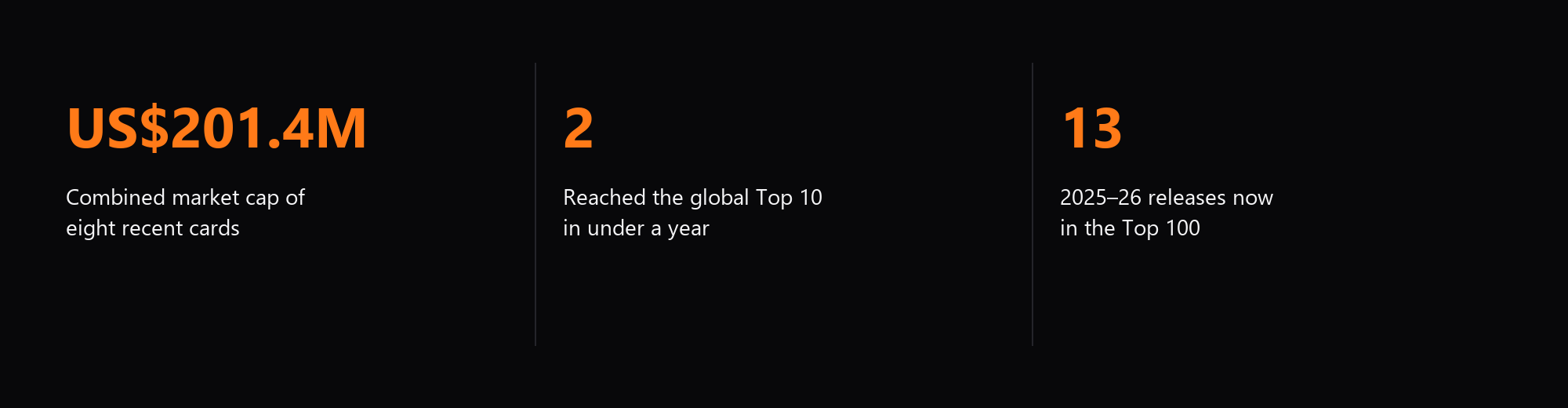
The headline numbers are impressive. The speed behind them is more consequential. Thirteen cards in the latest Pokémon Top 100 were released in 2025 or 2026, and two have already reached the Top 10. The eight recent cards examined here carry an estimated combined market cap of US$201.4 million. Every one of them is less than a year old; each has already built a PSA 10 market cap of more than US$13.5 million.
The clearest examples are the two Mega Charizard X ex cards:
The English Phantasmal Flames 125/094 sits at No. 6, with a PSA 10 reference price of about US$1,911, a population of 29,548, and an estimated market cap of US$56.48 million.
The Japanese Inferno X 110/080 ranks No. 8, with a PSA 10 reference price of about US$1,063, a population of 49,534, and an estimated market cap of US$52.64 million.
Together, the pair accounts for roughly US$109.1 million in estimated market cap. The English card was released on 14 November 2025; the Japanese card arrived on 26 September 2025. At the 15 August 2026 snapshot, neither had reached its first anniversary—yet both were already competing with classics whose collector consensus took years to form.
That is the remarkable part: these are first-year cards with blue-chip-scale capitalization.
Where the Eight New Cards Rank
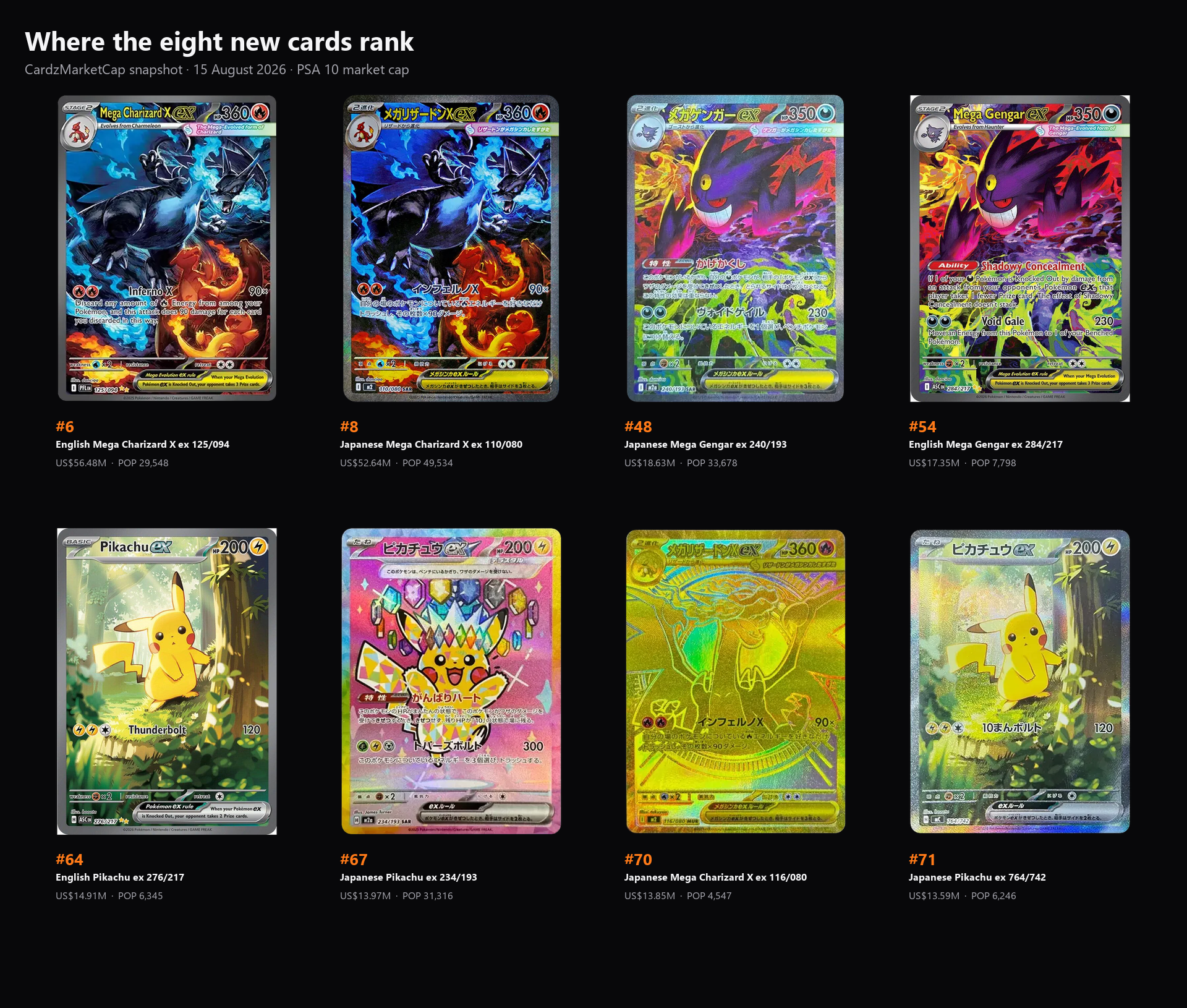
- #6 English Mega Charizard X ex 125/094 — US$56.48M · POP 29,548
- #8 Japanese Mega Charizard X ex 110/080 — US$52.64M · POP 49,534
- #48 Japanese Mega Gengar ex 240/193 — US$18.63M · POP 33,678
- #54 English Mega Gengar ex 284/217 — US$17.35M · POP 7,798
- #64 English Pikachu ex 276/217 — US$14.91M · POP 6,345
- #67 Japanese Pikachu ex 234/193 — US$13.97M · POP 31,316
- #70 Japanese Mega Charizard X ex 116/080 — US$13.85M · POP 4,547
- #71 Japanese Pikachu ex 764/742 — US$13.59M · POP 6,246
Source: CardzMarketCap snapshot, 15 August 2026. Rankings, market caps, and PSA 10 population figures follow the platform’s methodology.
What the Gray Blocks on the Heatmap Really Mean
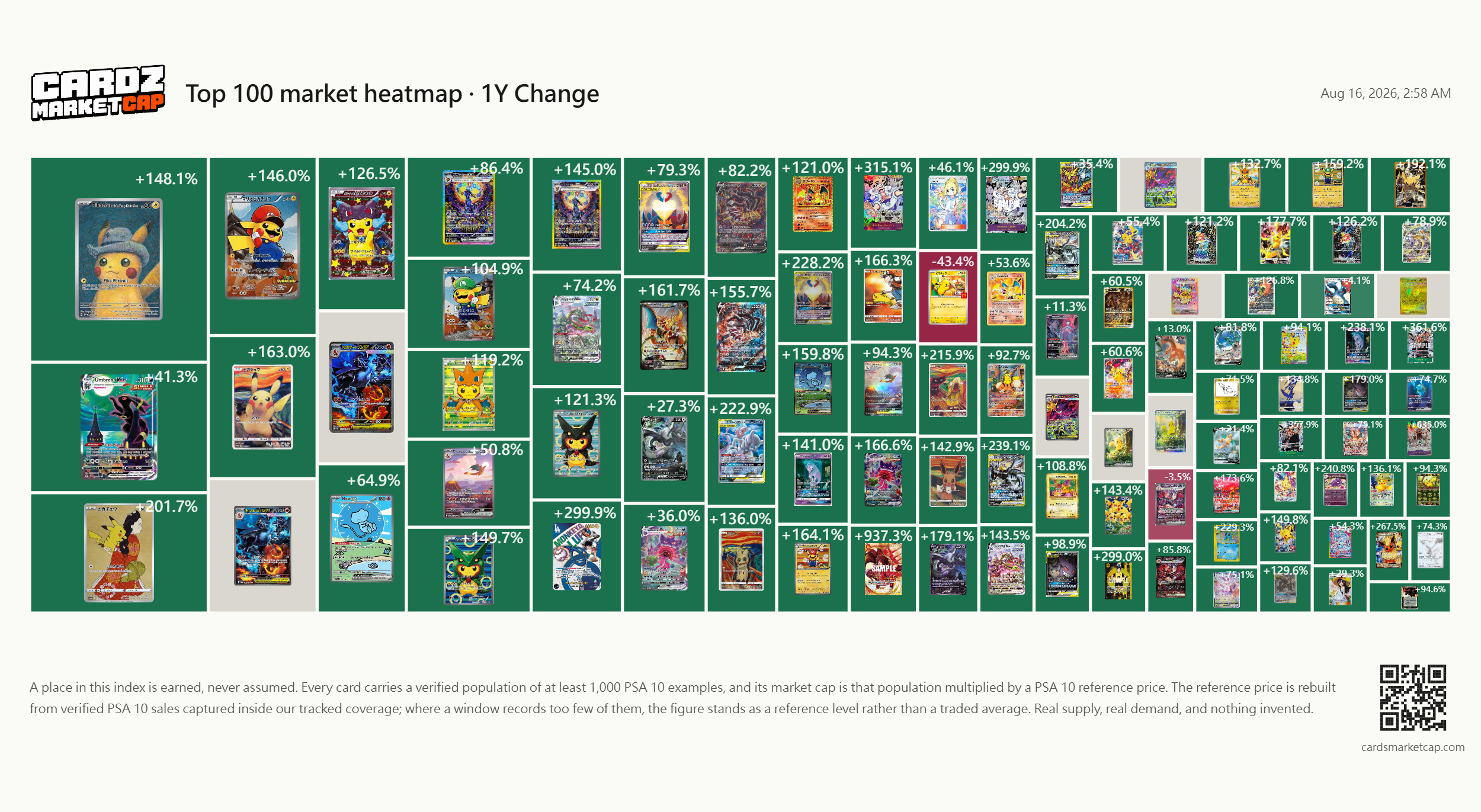
On the CardzMarketCap 1Y heatmap, gray does not mean flat performance or absent demand. It means the data is still maturing, or that no valid one-year price anchor exists. The system looks for the most recent valid price recorded on or before the date 365 days earlier. If no such price exists, it leaves the one-year return blank rather than manufacturing a comparison.
For cards released in 2025 and 2026, that absence is revealing. These assets do not yet have a full year of price history, but their market caps are already large enough to place them in the Top 100—and, in two cases, the Top 10.
The relevant question is therefore not, “How much did they rise in a year?” It is, “How little time did they need to build this much market value?”
Population Is Not Just Dilution—It Can Multiply Market Cap
Traditional collectibles logic treats a high population as evidence that an item is not scarce enough—and therefore has limited upside. Market-cap analysis shows why that relationship is more complicated.
Estimated market cap is calculated as price multiplied by PSA 10 population. When a card can sustain a price in the hundreds or thousands of dollars across tens of thousands of graded copies, population is no longer only a source of dilution; it also becomes a multiplier. Four of the eight cards in this group already have PSA 10 populations above 29,000. Even the smallest population is 4,547.
This suggests that the center of gravity in the modern card market is shifting. Asset status is no longer defined by scarcity alone. It increasingly depends on whether a card can achieve broad ownership, attract grading at scale, and sustain enough global demand to support its price at the same time.
That is closer to the structure of a mass-market asset than an antique traded among a small circle of specialists.
English and Japanese Markets Are Converging
The English and Japanese Mega Charizard X ex cards both sit in the Top 10. Japanese and English Mega Gengar ex rank No. 48 and No. 54; English and Japanese Pikachu ex rank No. 64 and No. 67. The artworks are not always identical, but the characters, release era, and high-rarity narrative are closely aligned.
That pattern suggests capital is not simply chasing a short-lived trend in one region. Collectors across Asia, North America, and elsewhere are converging on the same visual language: Charizard anchors the top end, Pikachu broadens the audience, and Gengar carries a subcultural aesthetic into the mainstream.
When markets in different regions begin agreeing on what is worth holding, price discovery accelerates and market cap forms faster. That convergence is one of the clearest signals of pre-financialization.
Van Gogh Pikachu Challenges the “High POP, Low Potential” Rule
At the same cutoff, the 2023 Pikachu with Grey Felt Hat carried a PSA 10 reference price of about US$2,836, a population of 49,787, and an estimated market cap of US$141.2 million—enough to rank No. 1 across the Pokémon market.

The outcome is a direct challenge to one of the market’s most persistent assumptions. A card once criticized for rising supply, rapid population growth, and the opportunity cost of holding it now sits at the top of the ranking.
That does not mean every entry price was attractive, nor does a market-cap ranking prove that the card outperformed every alternative asset. It does, however, invalidate a simplistic rule: high population does not automatically prevent a card from becoming a major asset. When demand grows quickly enough to absorb supply, a larger population can support a larger total market cap.
Grading a card and valuing a market are, after all, two very different disciplines.
Case Study: AI-Era Grading Meets Scarcity-First Investing
On 26 December 2025, Jesse Peng wrote publicly on Xiaohongshu (translated):
Do not buy Van Gogh Pikachu as an investment. It is the most heavily graded card in history. Putting money into it instead of trophy cards or low-POP vintage cards will cost you dearly in missed opportunities.


The significance of the comment is not that one person “got a card wrong.” It is that the post compresses a broader conflict between two valuation frameworks into a single example. The original argument follows the classic collectibles model: lower supply is better, lower population is better, and trophy or vintage cards are the preferred home for capital. Yet the latest CardzMarketCap snapshot places Van Gogh Pikachu—with a PSA 10 population of 49,787—at No. 1 by Pokémon market cap, at an estimated US$141.2 million.
The contrast is striking. TAG’s own materials describe a grading process that uses machine-learning imaging software and patented capture technology to analyze defects, followed by human review. The grading system has entered the machine-learning era; the investment thesis above still reflects a low-POP, scarcity-first framework. Technology changed how condition is measured. It did not automatically change how markets are interpreted.
An important distinction remains: this was Jesse Peng’s personal market view, not evidence of TAG’s corporate investment policy. Nor does Van Gogh Pikachu’s No. 1 market-cap position prove that it outperformed every low-population vintage card from every possible entry date. What it does show is that high population can no longer be treated as an automatic disqualifier in the modern TCG market.
Sources: TAG official About page, TAG’s official explanation of AI and machine-learning grading, public Xiaohongshu screenshots supplied by the author, and the CardzMarketCap snapshot dated 15 August 2026.
One Market, Two Valuation Regimes
The divide is not simply “old cards versus new cards.” It is a difference in how assets are formed, owned, traded, and priced.
The Legacy Model: Scarcity-First Trophy Assets
The legacy model is built around low populations, historical scarcity, very high unit prices, and recognition among a relatively small group of elite collectors. These assets can be extraordinarily valuable and culturally important. But ownership is often concentrated, transactions are less frequent, spreads are wider, and price discovery depends heavily on specialist consensus. Value can be high even when market depth is limited.
The Emerging Model: Liquidity-First Networked Assets
The emerging model is built around broader ownership, standardized identity, grading at scale, continuous price observation, cross-border transactions, and globally recognized characters. High population is no longer only supply pressure. When demand can absorb that supply, population also becomes a multiplier in the market-cap equation. The defining question expands from “How scarce is it?” to “How many people will hold it, how often can it trade, and can the market converge on a common price?”
The dividing line is not age. A vintage card with sufficient transparency and liquidity can participate in the emerging model; a modern card with publicity but no durable demand does not automatically qualify as an asset. The shift is away from unit-price worship and toward a market that prices supply, demand, liquidity, and total capitalization together.
Seen through this lens, even market participants connected to machine-learning-based grading can interpret a next-generation market through a previous-generation scarcity model. The question is not whether AI is intelligent. It is whether the analytical framework has kept pace with the market it is trying to explain.
A Necessary Correction: Market-Cap Formation Is Not Cash Inflow
Precision matters here. CardzMarketCap estimates the value of an outstanding graded population; it does not measure turnover, trading volume, capital flow, or net inflows. A US$100 million increase in market cap does not mean buyers injected US$100 million in cash. A higher marginal transaction price can revalue the entire population.
For that reason, the claim that “the past year attracted as much capital as the previous three or four years combined” cannot be presented as established fact. Proving it would require comprehensive transaction-value, volume, source-of-funds, and period-specific net-flow data.
What the evidence does support is more precise—and arguably more important: in 2025–26, newly released Pokémon cards have built major market capitalizations far faster than conventional assumptions about modern cards would suggest.
That acceleration is the structural change worth watching.
Conclusion: The Real Contest Is Over Pricing Power
Pre-financialization does not mean cards have become stocks. It means the market is beginning to observe them through a framework associated with financial assets: each card has an identity, a visible supply, a price, a liquidity profile, and a market cap. Each major set launch increasingly resembles a small asset-issuance event.
Collectors once asked: “Do I love this card?”
Now the market also asks: “How many exist? At what price? How often does it trade? What is the total market cap? Who is buying?”
Once the conversation shifts from taste to data, from unit price to market cap, and from regional hype to global consensus, the market has moved beyond the blind-box model.
It is not fully financialized. But it is no longer only a collectibles market.
Data as of 15 August 2026. Market capitalization is a market-structure indicator, not a single-card price quote or investment recommendation.